


Regulation (EU) 2023/2854, also called EU Data Act, entered into force in January 2024 and applies as of 12 September 2025. Overall, the new rules have a wide scope and apply to manufacturers of connected products, users of connected products, data holders, data recipients, public sector bodies, providers of data processing services, and participants in data spaces and vendors of applications using smart contracts.
The EU Data Act aims at giving both consumers and businesses greater control over the data generated by their connected devices and covers both personal and non-personal data.
Manufacturers of connected devices must comply with the new data sharing rules
Chapter II of the Data Act sets the requirements for business-to-business and business-to-consumer data sharing. The provisions address all raw and pre-processed data generated from the use of a connected product or a related service that is readily available to the data holder (e.g. manufacturer of a connected product or a provider of a related service). Such data includes data collected from a single sensor or a connected group of sensors, such as temperature, pressure, flow rate, audio, pH value, liquid level, position, acceleration, or speed (European Commission 2025).
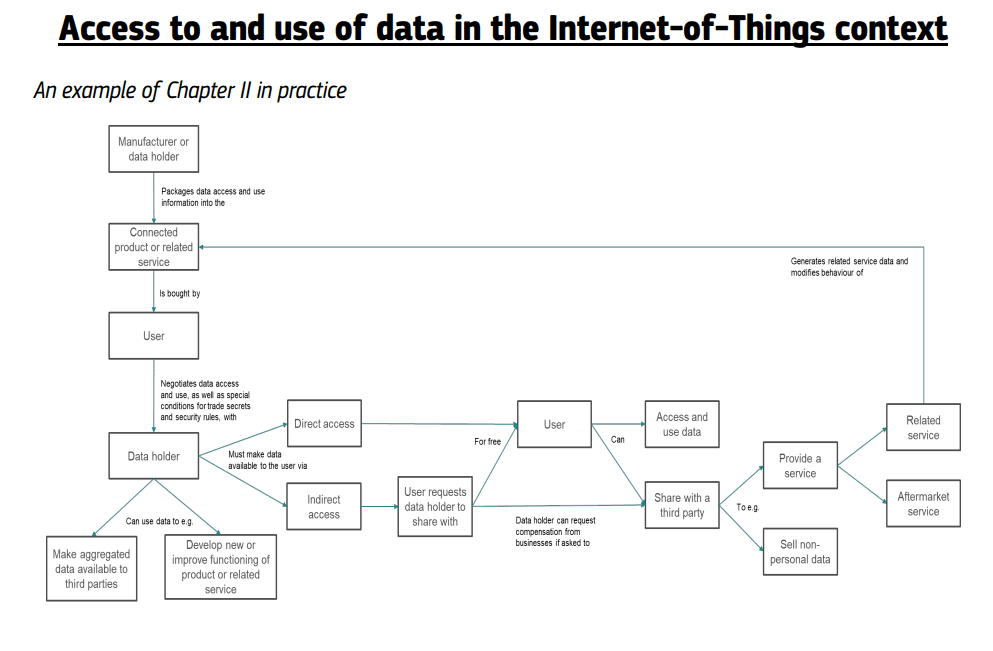
Other chapters of the Regulation address:
- Business-to-business data sharing (Chapter III)
- Unfair contractual terms (Chapter IV)
- Business-to-government data sharing (Chapter V)
- Switching between data processing services (Chapter VI)
- Unlawful third country government access to data (Chapter VII)
- Interoperability (Chapter VIII)
- Enforcement (Chapter IX)
Stay up-to-date about all regulatory news. Become member of PRODlaw today. It is free!
Questions? Contact us here or at prodlaw@obelis.net.
References
European Commission (2025). Data Act explained. Retrieved on 16/10/2025.
European Commission (2024). Commission publishes Frequently Asked Questions about the Data Act. Retrieved on 16/10/2025.
Leave a Reply