


The new EU regulatory framework is expected to affect battery value chains globally by regulating the full lifecycle of batteries, from raw material sourcing to end-of-life management. . For the first time, batteries placed on the Union market will be subject to concrete carbon footprint requirements outlined by recent Battery Regulation.
As defined in the Regulation, “carbon footprint” means “the sum of greenhouse gas emissions and greenhouse gas removals in a product system, expressed as carbon dioxide equivalents and based on a Product Environmental Footprint (PEF) study using the single impact category of climate change”. According to Article 7.1, the battery categories for which there shall be a carbon footprint declaration are electric vehicle batteries, rechargeable industrial batteries with a capacity greater than 2 kWh, and LMT batteries.
Information to be included in the carbon footprint declaration
The following information shall be part of the carbon footprint declaration:
- Administrative information about the manufacturer
- Information about the battery model
- Information about the geographic location of the battery manufacturing plant
- Carbon footprint of the battery, calculated as kg of carbon dioxide equivalent per one kWh of the total energy provided by the battery over its expected service life
- Carbon footprint of the battery differentiated according to life cycle stage as described in point 4 of Annex II (namely raw material acquisition and pre-processing, main product production, distribution, and end of life and recycling)
- Identification number of the EU declaration of conformity of the battery
- Web link giving access to a public version of the study supporting the carbon footprint values
Deadlines for providing carbon footprint declaration
Providing the declaration is mandatory according to the following deadlines:
- Electric vehicle batteries: 18 February 2025 or 12 months after the date of entry into force either of the delegated act or of the implementing act, whichever is the latest.
- Rechargeable industrial batteries (except those with exclusively external storage): 18 February 2026 or 18 months after the date of entry into force either of the delegated act or of the implementing act, whichever is the latest.
- LMT batteries: 18 August 2028 or 18 months after the date of entry into force either of the delegated act or of the implementing act, whichever is the latest.
- Rechargeable industrial batteries with external storage: 18 August 2030 or 18 months after the date of entry into force either of the delegated act or of the implementing act, whichever is the latest.
Until it becomes accessible via the QR code (mandatory from 18 February 2027), the carbon footprint declaration shall accompany the battery.
Public consultation on the carbon footprint declaration format
The Commission has opened a public consultation on harmonised specifications for certain labelling requirements, providing same design formats for all battery categories. Among others, the draft of the implementing regulation annex provides the format of the carbon footprint label:
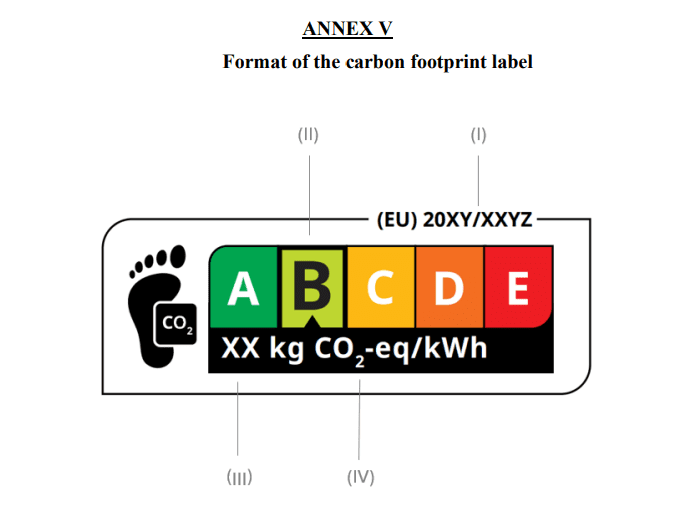
Where the carbon footprint label is printed or engraved on the surface of the battery, it may also be
displayed in the black and white format.
Stakeholders can submit their views here until 26 January 2026.
We act as authorised representative for batteries on the Union market. For any questions, contact us here today. PRODlaw Team is also available at prodlaw@obelis.net
References:
European Commission (2026). Draft implementing regulation laying down rules for the application of Regulation (EU) 2023/1542 of the European Parliament and of the Council as regards format and harmonised specifications for certain labelling requirements. Retrieved on 22/01/2026.
European Commission (2026). Annex to draft implementing regulation laying down rules for the application of Regulation (EU) 2023/1542 of the European Parliament and of the Council as regards format and harmonised specifications for certain labelling requirements. Retrieved on 22/01/2026.
EUR-Lex (2023). Regulation (EU) 2023/1542 of the European Parliament and of the Council of 12 July 2023 concerning batteries and waste batteries, amending Directive 2008/98/EC and Regulation (EU) 2019/1020 and repealing Directive 2006/66/EC. Retrieved on 22/01/2026.
Leave a Reply